
This is part of a series of lessons I have taken from my collaborative decision-making practice and applied to family life.
Meeting Purpose – Clean the House!
I love a tidy house. Clutter stresses me out, and I’m not a fun mom when I’m stressed. Therefore, we should just clean the house right away, and then Mom Days will be better for everyone, right? But telling my kids to tidy was a guaranteed way to start Mom Days with tantrums and fights.
My partner is a fun and engaging primary parent, which is a huge benefit to me. But stay-at-home parents need other projects, and working parents need quality time with their children. So on Mom Days, I’m in charge of everything. And I clearly needed a new approach.
On a Mom Day last year, the state of the house was putting me in survival mode. I needed the house to be tidied up, for my baseline functioning. So we held a Kid Meeting.
Meeting Agenda – Tell, Share, Plan
Many rounds of cuddles were first on the agenda, and then we got to it:
- Tell: I told them the messy house was stressing me out, and chores needed to be part of the Plan for Today. They agreed it might be hard to find some toys with the chaos in the playroom.
- Share: Instead of immediately making a plan to tackle it, we first shared how we felt about it. They talked about what they didn’t like about doing chores. They suggested some ways to make it fun.
- Plan: In this case, I did the planning on my own. I had the information I needed to move the group forward.
Meeting Results – A Game-Changing Approach to Chores
In the course of the meeting, they agreed the house needed work. They shared that they cleaned best when they had a specific assignment that matched their abilities. (That was something I wouldn’t necessarily have known if I hadn’t asked.) With those inputs, I designed a system that involved putting each small task on a slip of paper, color-coded according to its level of difficulty. Some had a star that meant “invite a partner to help you!” Each was folded and put into a basket. They randomly drew a paper slip from the basket to add a little mystery and excitement.
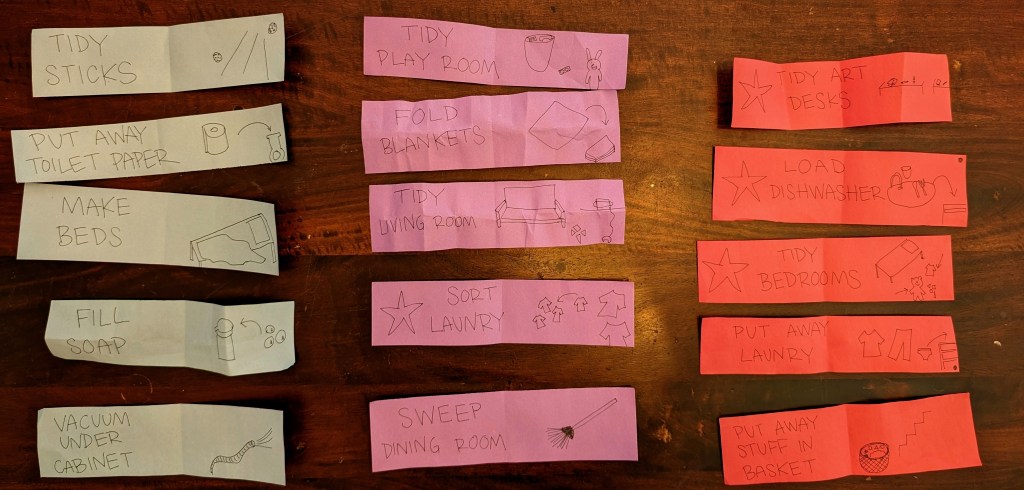
This went so well, it literally changed how I think about Mom Days.
The oldest was motivated and proud of doing more challenging chores, instead of claiming they were unfair. The youngest pulled a slip, figured out what it meant (based on my very rough drawings), and got it done enthusiastically and independently. It was adorable, and the toilet paper was distributed to bathrooms throughout the house. Another cheered when he got the chance to use dad’s fun workshop vacuum. And within an hour, you could walk into their rooms without fear of injury. Wins all around!
We play the Tidying Game now when we have a long list of chores and need an extra spark of motivation. It’s not always smooth, but it is a reminder to focus on more than just the outcome. Collaborative decision-making is as much about the journey as it is about the destination; it is both about the deliverable and the process we use to get there. While a tidy house is great, designing and playing the Tidying Game is also an opportunity to teach critical thinking and communication skills, while growing closer together.
 Mia L. Arter Consulting