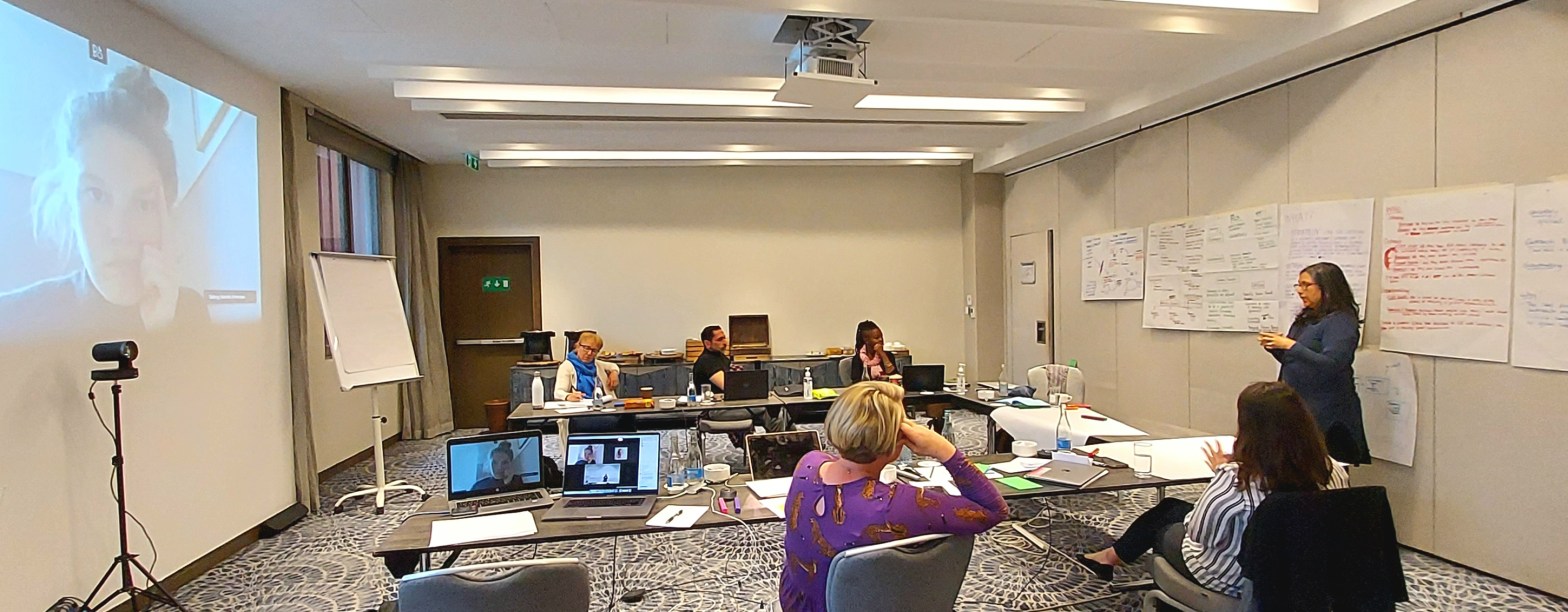
After producing my first hybrid meeting, I am convinced that I’ll never do another one like it. And not just because it was in Nairobi and preceded by a safari and site visit to a women’s cooperative in a Massai community.
By “hybrid meeting,” I mean a meeting where some participants were in the room and some were virtual; all participating synchronously.
This meeting had several distinctive features, which directed how we designed the agenda. It was an alignment meeting with a firm timeline. The work was complex. There were power dynamics to consider. And last but not least, it was not supposed to be hybrid: Shortly before the meeting, two participants were unable to travel.
But don’t all hybrid meetings have distinctive features? If a meeting is important enough to warrant an in-person conversation — even though not all members of the team can make it — then it likely requires unique care and attention.
More than ever, I am convinced that there is no single “right way” to design a hybrid meeting. Each must be unique to its context.
Some decisions we made were right in this context, but could be detrimental in others.
Should I use virtual or physical materials? It depends! In this case, we kept most of our original facilitation plan, which called for physical materials like poster boards, sticky notes, and maybe a dot vote or two. It worked in part because of group dynamics and the emergent style of conversation needed. In other cases, it might be better to have every participant contributing on the same platform like Mural.
When should virtual folks sign in? It depends! We chose not to ask virtual participants to join every minute of the agenda. This was the right call because of the significant time zone differences, the length of the meeting, and the important reasons virtual attendees were home.
Some decisions feel near-universal.
It is early in the days of thoughtful hybrid meetings — for me in the rest of the world — but some decisions feel like they might elevate to “good practice” status over time.
Do we need an event producer? Yes! I believe all significant meetings need an event producer (and not just because it’s a role I love!) This person attends to the details, making sure everyone is able to engage and that the materials are ready for the next item on the agenda. But be prepared for this role to take a lot more attention than other meeting types: I was struck by how often I was unable to listen deeply to the conversation.
Do we really need to invest in the full AV package? Yes! Equipment is always important, especially in a hybrid meeting. We had several tools for the meeting — two computers (one for the projector, one for managing the virtual room), a stand-alone camera to show the room, secondary cameras, lots of microphones — and we needed them all. (Shout out to the Radisson Blu for a great wide-angle video camera with remote control ability!)
Do we need reminders that virtual participants are in the room? Yes! We all know theoretically that the meeting is hybrid, but sometimes our brains will default to those physically with us. Setting the room to face the screen with video feeds or photos of those virtually in the room is useful. Even facilitators might need a reminder not to block the camera when deeply engaged in the conversation!
In short, hybrid meetings require a level of customization and intentionality that is both fun and daunting to deliver. But being intentional is how we change the world, right?
Let’s connect and talk hybrid meeting experiences!
 Mia L. Arter Consulting